

How Small Businesses Drive Economic Growth and Innovation
How do small businesses benefit the economy?
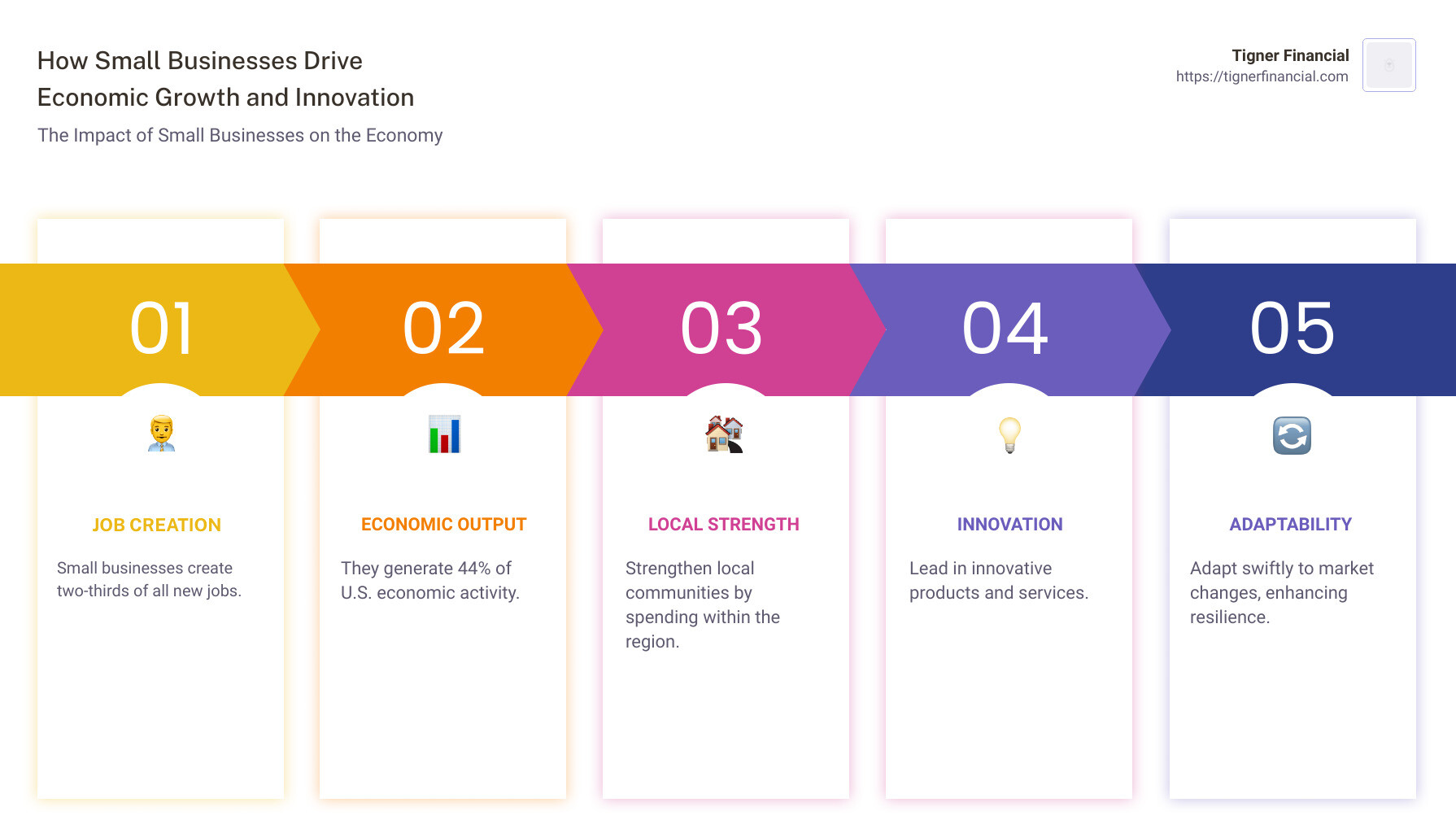
– Job Creation: Small businesses create two-thirds of all new jobs.
– Economic Output: They generate 44% of U.S. economic activity.
– Local Strength: They strengthen local communities by spending within the region.
– Innovation: Small businesses lead in innovative products and services.
– Adaptability: They adapt swiftly to market changes, enhancing resilience.
Small businesses are the backbone of the American economy. Despite their smaller size, they have a disproportionate impact on economic growth and innovation.
Small businesses create a significant number of jobs and drive local economic activity. As noted by the U.S. Small Business Administration, small enterprises generated 44% of all economic activity in the U.S. and were vital to post-pandemic recovery. Their ability to adapt and thrive, even in challenging times, keeps communities vibrant and employment rates stable.
I’m Dalton Tigner, an expert in financial solutions for small businesses with a family-owned company since 1992. My focus is on how small businesses benefit the economy, ensuring financial security and growth for both businesses and their employees.
The Role of Small Businesses in Job Creation
Small businesses play a crucial role in job creation and employment growth. According to the U.S. Small Business Administration (SBA), small businesses created a net 12.9 million new jobs over the past 25 years. This accounts for roughly 66% of all jobs created in that period.
Employment Growth
The numbers speak for themselves. While large businesses added a net 6.7 million jobs in the same 25-year span, small businesses more than doubled that figure. This massive contribution highlights how small businesses are the backbone of employment growth in the U.S.

Source: Forbes Business Council
Local Jobs
Small businesses don’t just create jobs; they create local jobs. Unlike large corporations that may outsource various functions, small businesses often hire locally. This local hiring helps keep money within the community. According to Stephan Goetz, a professor at Penn State, small businesses tend to generate higher incomes for people in a community than big, nonlocal firms.
“Small, locally owned businesses and startups tend to generate higher incomes for people in a community than big, nonlocal firms, which can actually depress local economies.”
— Stephan Goetz, Penn State
Post-Pandemic Recovery
The resilience of small businesses was especially evident during the COVID-19 pandemic. In the first two quarters of 2020, 9.1 million jobs were lost. However, in the following four quarters, small businesses created 5.5 million jobs, recovering 60% of the jobs lost. This quick recovery underscores their ability to adapt and thrive even in challenging times.

Source: Forbes Business Council
Small businesses are vital for maintaining stable employment rates and keeping communities vibrant. Their role in job creation and employment growth cannot be overstated.
Next, we’ll explore how small businesses benefit the economy through their support of local economies and their role in driving innovation and competition.
How Do Small Businesses Benefit the Economy?
Supporting Local Economies
Small businesses are the backbone of local economies. When you spend $100 at a local business, about 68% of that money stays within your community. In contrast, only about 48% stays local when you shop at a big business.
Why does this matter?
Local Spending: Small businesses often source their services and products locally. This means they hire local accountants, lawyers, and suppliers, keeping money circulating within the community.
Community Support: By supporting local businesses, you help create a ripple effect. Local businesses pay local taxes, which fund public services like schools, parks, and emergency services.
Paychecks and Taxes: Small businesses contribute to the local economy by paying wages to local employees. These employees, in turn, spend their paychecks locally, further boosting economic activity. Moreover, the taxes paid by small businesses help fund critical community infrastructure and services.
Stephan Goetz, a professor at Penn State, notes that small businesses generate higher incomes for local communities compared to big, nonlocal firms. This is because large corporations often have centralized services, whereas small businesses need to outsource, creating more local jobs and economic activity.
Driving Innovation and Competition
Small businesses are hotbeds of innovation and competition. They bring fresh ideas and new products to the market, often faster than larger companies.
Innovation: Small businesses produce 16 times more patents per employee than large firms. This higher rate of innovation is crucial for economic growth and technological advancement.
Competition: Small businesses keep larger companies on their toes. They create a competitive environment that fosters efficiency and better customer service. This competition benefits consumers by providing more choices and better products.
Efficiency: Small businesses are often more adaptable and can implement changes quickly. This agility allows them to meet customer needs more effectively and stay competitive.
Martin Rowinski, CEO of Boardsi, points out that small businesses draw in talent and innovation, which larger corporations often lack the flexibility to incorporate. This is why big companies frequently acquire small startups to boost their innovation.
In summary, small businesses play a critical role in supporting local economies and driving innovation and competition. Their contributions to economic growth and community well-being are immense.
Next, we’ll discuss the environmental and charitable contributions of small businesses.
Environmental and Charitable Contributions
Small businesses are not just economic powerhouses; they also play a significant role in environmental sustainability and charitable activities. Let’s explore how.
Sustainability
Small businesses often lead the charge in sustainability. Unlike large corporations, they can quickly adapt to eco-friendly practices. For instance, many small businesses source their products locally, which reduces the carbon footprint associated with long-distance transportation. This local sourcing not only supports the local economy but also helps the environment.
A great example is Bee’s Wrap, which offers sustainable food storage options that cut down on plastic usage. This kind of innovation shows how small businesses can be more agile and responsive to environmental concerns compared to their larger counterparts.
Charitable Donations
Small businesses are also known for their charitable contributions. According to research, 66% of small business owners donate to charity. These donations can range from sponsoring local events to supporting non-profits that address community needs.
For example, during the COVID-19 pandemic, Battery Watering Technologies pivoted from making battery equipment to producing face shields. They sold 6,000 face shields a day, showing their adaptability and commitment to public health. This kind of quick thinking and community support is a hallmark of small businesses.
Local Sourcing
Local sourcing is another area where small businesses excel. By buying from local suppliers, they keep money within the community and reduce the environmental impact of shipping goods over long distances. This practice not only supports other local businesses but also fosters a sense of community and mutual support.
For instance, local farmers’ markets are a great place to see this in action. By shopping at these markets, consumers support local farmers, which boosts the local economy and promotes a healthier food system.
Boosting Environmental Sustainability
Small businesses often have a smaller environmental footprint compared to large corporations. They can implement sustainable practices more easily and are often more committed to environmental stewardship. As a result, they contribute to a more sustainable future.
In summary, small businesses are not just economic drivers; they are also champions of sustainability and community support. Their ability to source locally, donate to charities, and adopt eco-friendly practices makes them invaluable to both the economy and the environment.
Next, we’ll explore the resilience and adaptability of small businesses.
The Resilience and Adaptability of Small Businesses
Small businesses are incredibly resilient and adaptable, especially during times of economic uncertainty. Their ability to pivot quickly and meet new demands sets them apart from larger corporations.
Economic Uncertainty
The COVID-19 pandemic is a prime example of how small businesses can thrive even in challenging times. While many large companies struggled, small businesses showed remarkable resilience. For instance, Battery Watering Technologies quickly adapted by using its existing equipment to produce face shields, selling 6,000 units a day through an e-commerce website. This swift action helped them keep all 50 employees working during the crisis.
This resilience isn’t just limited to pandemics. Small businesses are also better equipped to handle economic downturns. They can adjust their strategies quickly to respond to market changes, ensuring they continue to serve their customers effectively.
Adaptability
Small businesses can adapt to new market trends and consumer demands faster than large enterprises. This agility is a significant advantage in today’s world. According to a report, small businesses created 5.5 million jobs in the four quarters following the first half of 2020, recovering 60% of the jobs lost during the initial pandemic period.
Bee’s Wrap, for example, capitalized on the growing demand for eco-friendly products by offering sustainable food storage options. This adaptability to consumer preferences not only meets market demands but also sets trends that larger companies often follow.
Customer Focus
Small businesses excel in maintaining a strong focus on customer needs. They often provide personalized services and products that large corporations can’t match. This customer-centric approach builds loyalty and drives repeat business.
During the pandemic, many small businesses adapted by offering curbside pickups and personalized online services. This focus on customer convenience and safety helped them maintain their customer base even when physical stores were closed.
The adaptability and customer focus of small businesses make them resilient in the face of economic challenges. Their ability to quickly pivot and meet new demands ensures they remain vital to the economy.
Next, we’ll address frequently asked questions about how small businesses benefit the economy.
Frequently Asked Questions about How Small Businesses Benefit the Economy
How do small businesses contribute to job creation?
Small businesses are a major driver of job creation. According to the U.S. Small Business Administration (SBA), small businesses created a net 12.9 million new jobs in the last 25 years, accounting for roughly 66% of all jobs created during that period. This means that while large companies often get the headlines, small businesses are quietly but significantly contributing to employment growth.
For example, during the initial months of the COVID-19 pandemic, the economy lost 9.1 million jobs. However, in the following year, small businesses bounced back, creating 5.5 million jobs, marking a 60% recovery. This resilience underscores the critical role small businesses play in job creation and economic stability.
Why are small businesses important for local economies?
Small businesses are vital to local economies for several reasons. When you spend money at a local business, a significant portion of that money stays within the community. It’s estimated that if you spend $100 at a local business, about $68 stays in the local economy compared to $48 if spent at a large chain.
Small businesses also support local services. They hire local accountants, lawyers, and maintenance services, which keeps money circulating within the community. Stephan Goetz, a professor at Penn State, emphasizes that small businesses generate higher incomes for local people compared to large, nonlocal firms, which can actually depress local economies.
Moreover, small businesses contribute to the community through paychecks and taxes. The money earned by employees and the taxes paid by businesses help fund local public services like schools, parks, and emergency services.
How do small businesses drive innovation?
Small businesses are often at the forefront of innovation. They have the flexibility to experiment and implement new ideas quickly. According to the SBA, small businesses applied for 29,583 patents in 2018 and received 12,837. While large businesses have a higher patent approval rate, small businesses are more prolific when it comes to patent applications per employee.
For instance, businesses with one to four employees applied for about 270 patents per 1,000 employees, almost 25 times the rate of any other business size. This high rate of innovation is because small businesses are closer to their customers and can quickly adapt to meet their needs.
Small businesses also foster competition. They challenge larger companies to improve their products and services, leading to better options for consumers. This competitive environment drives efficiency and innovation across industries.
In summary, small businesses are essential for job creation, local economic support, and driving innovation. Their contributions go beyond just economic metrics; they enrich communities and foster a spirit of creativity and resilience.
Conclusion
Small businesses are the backbone of our economy. They create jobs, support local economies, and drive innovation. By being adaptable and resilient, they can respond quickly to changes and challenges, making them crucial players in both local and national economic growth.
Supporting small businesses means investing in our communities. These enterprises keep money circulating locally, create a sense of community, and offer unique products and services that enrich our lives. Moreover, small businesses often give back through charitable donations and sustainable practices, further enhancing their positive impact.
At Tigner Financial, we understand the importance of small businesses and are dedicated to helping them thrive. We offer tailored solutions to support small business growth, including comprehensive employee benefits packages. Our goal is to provide the tools and knowledge you need to attract and retain top talent, ensuring your business’s success and sustainability.
By supporting small businesses, we not only help them succeed but also contribute to a healthier, more dynamic economy. Let’s continue to champion these vital enterprises and recognize their significant role in driving economic growth and innovation.
Together, we can build a brighter future for small businesses and our communities. Contact Tigner Financial today to learn more about how we can help your business thrive.


